In short
- 45D usually means 45 kg/m³. It is a density, not a firmness or quality grade.
- Ask for density, thickness and firmness for each layer of each cushion position.
- Approve the finished seat, not a loose foam block or a single number.
45D, 50D and 55D at a Glance
| Label | Density (kg/m³) | Approx. lb/ft³ | What it does not tell you |
|---|---|---|---|
| 45D | 45 | 2.81 | How firm the seat feels, how much it bounces, how thick the layer is, or which part of the cushion it is in |
| 50D | 50 | 3.12 | |
| 55D | 55 | 3.43 |
What Does the “D” in 45D Mean?
In Chinese furniture quotations, D is normally shorthand for density in kilograms per cubic metre, so 45D means 45 kg/m³. Confirm this in writing before comparing offers. Some sellers use similar codes for model names or grades, and a code is not a measured property.
Density is mass per unit volume. It says nothing about cushion thickness or the force needed to compress the seat, and it belongs to one material or layer, not automatically to the whole sofa.
Converting kg/m³ to lb/ft³
US and UK suppliers often quote foam in pounds per cubic foot. One lb/ft³ is about 16.0185 kg/m³, a factor that follows from the pound and foot definitions in the NIST conversion guide. Divide kg/m³ by 16.0185 to get lb/ft³; multiply to go the other way.
| kg/m³ | 25 | 35 | 45 | 50 | 55 |
|---|---|---|---|---|---|
| lb/ft³ | 1.56 | 2.19 | 2.81 | 3.12 | 3.43 |
Worked example: one quotation lists 50 kg/m³ and another 3.1 lb/ft³. The second converts to about 49.7 kg/m³, so the stated densities are close. That still does not make the cushions equivalent; check each supplier’s tolerance, which layer the figure describes and its thickness.
In your comparison sheet, keep the original value, the original unit and the converted value in separate columns, and round only the converted one. If a listing just says “3 lb foam”, ask whether that means 3 lb/ft³ or the weight of the cushion.
Is Higher-Density Foam Firmer?
Not necessarily. The Polyurethane Foam Association (PFA) treats density and firmness as separate properties: density is mass per volume, while firmness is the force needed to indent the foam by a set amount (IFD). Foams of similar density can be made soft or firm.
Higher density is generally associated with better durability, but it does not tell you which finished sofa will feel softer. So a 55D cushion is not automatically “better” than a 45D one. Ask for a firmness figure with its test method alongside the density, and judge the seat itself.
Initial firmness vs deeper support
Two foams can feel the same when you first sit down and differ once your weight settles. PFA defines support factor as the force at 65% indentation divided by the force at 25%. For example, foam A measures 100 N at 25% and 200 N at 65%; foam B measures 100 N and 250 N. Both start the same, but B resists deeper compression more (support factor 2.5 against 2.0). These figures are illustrative, not YEINIHOME test results.
A ratio hides absolute force: a foam reading 200 N and 400 N also has a factor of 2.0 but is twice as firm as A at both points. Ask for both underlying readings, not just the ratio.
Does Bouncy Foam Mean a Softer Seat?
No. Bounce is resilience, which PFA measures by how high a steel ball rebounds from the foam. Firmness is a different test. A foam can spring back readily and still feel too firm, and a density label tells you neither. When a quotation says “high resilience”, ask for the material specification and any rebound test result rather than assuming a percentage.
Fast rebound is also not a lifespan test. If a sample seat feels wrong, describe what you notice: too much resistance as you sit down, too much springiness as you settle, or too little support once settled. That description helps the factory identify which layer to change.
Ask for Every Layer, in Every Cushion
A seat cushion is often several foams, sometimes with a fibre wrap or a down-and-feather bag on top. “50D sofa” leaves open whether 50D is the thin comfort layer or the core carrying the load. Ask for a section drawing or labelled photo with the density and thickness of each layer.
Seat and back cushions are specified separately
A seat cushion carries your weight; a back cushion meets your body as you lean. PFA’s furniture-design bulletin treats the firmness relationship between seat and back as a design choice, so the two often use different foams. There is no universal rule that the back must be softer. Record a specification for each named position (left seat, centre back and so on) and don’t treat inserts as interchangeable because their labels match.
Can You Check Foam Density by Weighing a Cushion?
Not reliably. Density is the mass of a foam divided by the volume of that same foam. A finished cushion also includes the cover, zip, lining, wrap and any feather bag, and its rounded edges make length × width × height larger than the foam’s actual volume. Different layer combinations can also add up to the same total weight.
Weighing is still useful for incoming inspection if you call it what it is. Record “complete cushion weight” and what was included, then compare matched cushions under the same method. A difference is a reason to ask the supplier, not proof of density. Shipping weight is no help: it includes packaging, frame and hardware. If formal verification is needed, agree the sampling and test method with a qualified laboratory instead of cutting a finished cushion.
Can You Add Extra Foam to a Sofa Cushion?
You can, but it changes the seat you approved. Extra thickness raises seat height, can reduce usable depth and strains the cover. PFA describes comfort as a system of foam, cover, frame, support and seat geometry, so judge any change in the finished cushion, not as a loose sheet.
Start by naming the problem. A loose-looking cover, a seat that feels too low and a cushion that has shifted are different issues, and switching to higher-density foam fixes none of them by itself. Extra foam also won’t fix a damaged seat support; have that checked separately. If a cover only closes by forcing the zip, the insert doesn’t fit.
For a replacement or addition, send:
- the model, order reference and cushion position;
- whether you need the bare core, a wrapped insert or the complete cushion;
- the intended dimensions and shape, including any front profile;
- photos of the whole seat and the problem you want to solve.
Foam Specification Checklist for Quotations
- Density and unit for each named layer, with the supplier’s tolerance.
- Thickness of each layer and the complete cushion construction, including wraps and feather bags.
- Firmness (IFD) with its test method, and both readings if a support factor is quoted.
- A separate specification for seat and back cushions.
- Durability or recovery information relevant to the use, such as hotel or rental seating.
- The approved sample reference and which material substitutions are allowed.
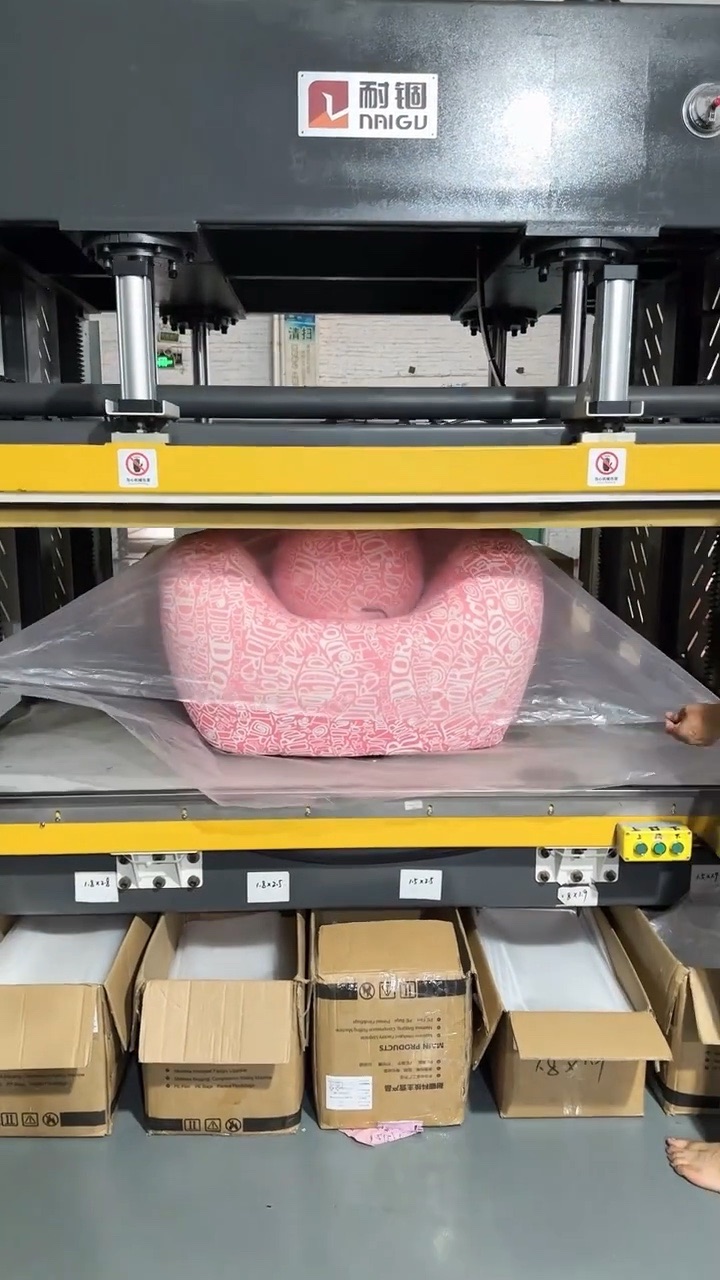
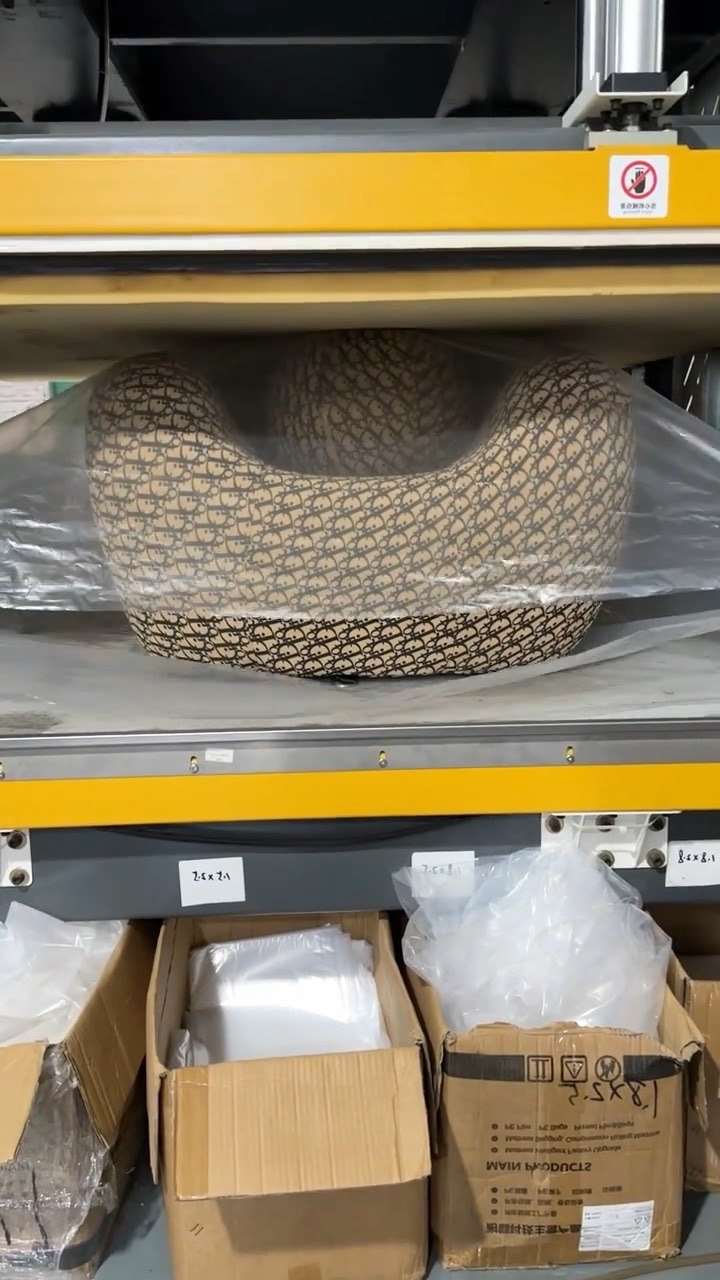
Compare samples with the same people doing the same things: sitting upright, leaning back and getting up. Record seat height and usable depth, and keep the approved sample reference with the order so a later change in cover or filling isn’t mistaken for the original. For compressed (roll-packed) sofas, also check how a packed sample recovers after unpacking; see our guide to approving a compressed sofa packaging sample.
Foam Used in YEINIHOME Sofas
YEINIHOME makes its sofas in its own factory in Foshan. We commonly use 45D, 50D and 55D foam in layers chosen for the seat cushion, the back cushion and the model. Some models add a down-and-feather bag using goose feather and down with fine quills; the exact filling varies by model, so confirm it for the one you select.
When you send an enquiry, name the model and ask for the layer specification of the seat and back cushions. If you are comparing offers, include the other specification in the same units so the figures can be checked side by side.
Frequently Asked Questions
Is 55D foam better than 45D?
Not automatically. 55D is denser, which generally helps durability, but density does not set firmness or comfort. Compare the full cushion construction and sit on the sample.
Is 50D the same as 3.12 lb/ft³?
Yes, if the supplier confirms that 50D means 50 kg/m³. The conversion does not make two foams equivalent in construction or firmness.
Does 55D foam bounce more than 45D?
Density does not tell you. Bounce is resilience, a separate test. Ask for it if it matters to you.
Can two cushions with different foam weigh the same?
Yes. Foam volume, layer combination, cover and other filling all affect the total, so equal weight does not mean equal foam.
Can I move a back cushion insert into the seat?
Not unless the maker approves it. Similar dimensions don’t mean the insert gives suitable seat support.
Do you accept small orders for sample seats?
Yes. YEINIHOME accepts orders from one piece per model, so you can approve a seat before a larger order.
Sources and References
Polyurethane Foam Association: Foam performance (density, firmness, resilience, support factor)
Polyurethane Foam Association: Foam in furniture design (rev. 2016)