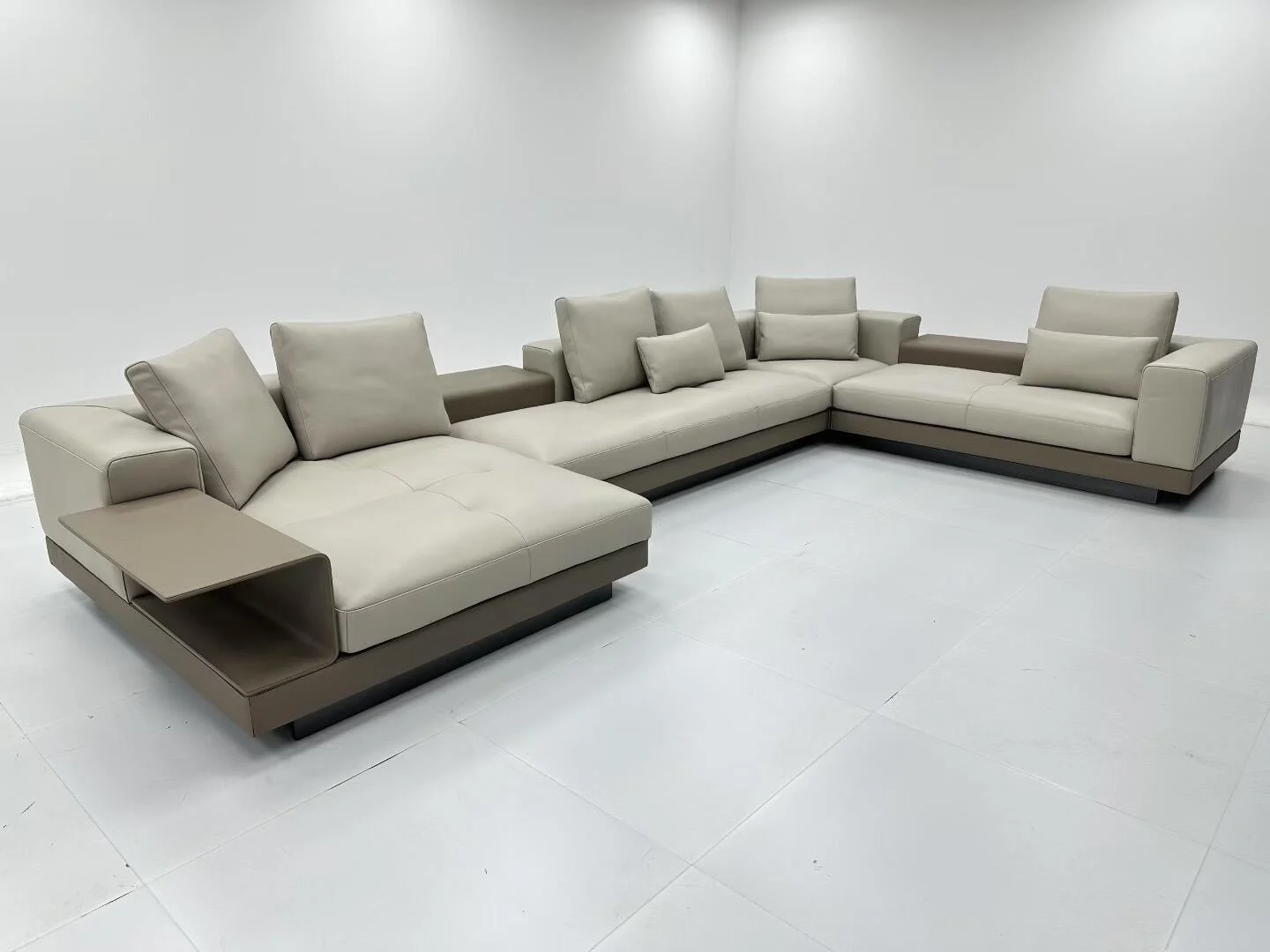
In short
- Mark the viewing direction on the plan so “left chaise” means the same thing to everyone.
- Compare inside seat width, not just overall width, when arms are wide.
- Draw the sofa from the side as well as from above if it goes near a window.
Planning Decisions at a Glance
| Decision | What to put on the drawing |
|---|---|
| Chaise side | Top view with an arrow showing the viewing direction |
| Arm width | Overall width and inside width between the arms |
| Chaise or ottoman | The footrest in use and where it is parked |
| Leg height | Finished seat height and the lowest point under the sofa |
| Window position | Side view with sill height and window opening path |
Which Side Should the Chaise Be On?
“Left-hand chaise” is ambiguous. Standing in front of the sofa, a chaise on your left is on your right once you sit down. Different sellers use different conventions, so put an arrow on the drawing and write a note such as: “Arrow shows the view from in front of the sofa. Chaise on the viewer’s left, beside the window.”
- Outline the full chaise projection and the main seat, and label each arm, the fixed back and any open end.
- Show module boundaries if the sofa comes in sections.
- Add the room entrance, door swings and furniture that stays nearby.
- Tape the footprint on the floor and walk your usual routes, including carrying a tray in.
Modular doesn’t mean reversible. Ask whether the chaise can move to the other end with the supplied parts and, if so, for the alternative assembly instructions. A mirrored product photo doesn’t prove it.
Do Wide Arms Reduce Seating Space?
Yes, within the same overall width. Ask for a top view showing both the widest outer points and the inner faces of the arms. On square arms, overall width minus both arm widths gives the inside width; curved or flared arms need the measurement marked at seat height.
Compare options on the same drawing within the same room width. If a wide-arm version needs a longer body to give you the seat space you want, recheck the room and the delivery route. Sit beside the arm to check whether it restricts your elbow or pushes the back cushion, and don’t count a broad arm as a seat or side table unless the maker says it is one.
Ottoman or Fixed Chaise?
A chaise is a fixed extended seat; an ottoman is a separate piece you can move. Draw two arrangements: the footrest in use, and where the ottoman goes when people need to walk through. If parking it blocks another seat or a door, choose a different layout.
Sit with the ottoman at its intended distance and check where its edge meets your legs; matching catalogue heights don’t feel the same once cushions compress. Ask whether a joining fitting exists or whether it is meant to stay separate, and whether it is rated as a seat or only a footrest. If it will be moved daily, check its weight and lift it rather than dragging it, which strains legs and joints.
Can You Fit Taller Legs?
Only with legs the maker approves for that model. A matching thread doesn’t mean the frame mounting or support layout suits a taller leg. Include every support in the request, including hidden centre feet and adjoining modules, and ask for the resulting finished seat height.
Start from why you want the change. For robot vacuum clearance, measure the lowest point across the whole underside, since a rail or centre support may sit lower than the visible edge. If the real issue is sinking too far into the seat, taller legs won’t fix it; that’s a cushion question.
Will the Sofa Block a Low Window?
A low frame can still have back cushions that rise above the sill. Draw a side view using the finished floor as the reference: the sofa’s full height with cushions, its distance from the wall, the sill, handle and the window’s opening path. A top-view plan misses these clashes.
Leave room to reach the handle, open and close curtains and clean, and keep heaters and vents in the review. Sunlight matters too. ACT notes that laboratory lightfastness hours don’t translate directly into real-world hours, and the Canadian Conservation Institute (CCI) advises keeping wooden furniture out of direct sun and away from heat. Ask for the lightfastness of the chosen fabric if the seat will catch direct sun.
Can an Indoor Sofa Go on a Covered Patio?
Only if the supplier confirms the whole model suits that environment. A roof doesn’t stop humidity, wind-driven rain or sun. ACT notes that the fabric supplier sets each textile’s intended use, indoor or outdoor; and CCI explains that wood absorbs and releases moisture as humidity changes, which affects frames.
Outdoor fabric alone doesn’t make an indoor sofa outdoor furniture; the frame, filling and connectors matter too. Send photos of the space and describe rain, sun, humidity and cleaning. If the model is approved for indoor use only, choose a verified outdoor product rather than relying on a cover.
Planning a YEINIHOME Sectional
In your enquiry, send the marked plan with the viewing arrow, the maximum outside width and the inside seat width you need, and a side view if a window is involved. Ask for the dimensions of the exact configuration, including full height with back cushions, and confirmation of the chaise orientation. YEINIHOME makes its sofas in its own factory in Foshan and accepts orders from one piece per model, so a single configuration can be approved before a larger order. Keep the final drawing with the quotation so a later fabric or size change doesn’t leave two versions of the layout.
Frequently Asked Questions
What is a left-facing chaise?
Conventions differ between sellers. Confirm it on a drawing with a viewing arrow before ordering.
Does modular mean reversible?
No. Ask which layouts are approved for those modules and fittings.
Can I use a wide arm as a side table?
Only if the surface is designed for it. Ask about load and surface care.
Can any ottoman be used as an extra seat?
Only if it’s specified for seating, not just as a footrest.
Does Italian-style mean made in Italy?
No. It describes the design. Check the country of manufacture in the product and order documents.
Sources and References
Association for Contract Textiles: Colorfastness to light
Association for Contract Textiles: Performance guidelines
Canadian Conservation Institute: Basic care of furniture and wooden objects
Polyurethane Foam Association: Foam in furniture design (rev. 2016)