In short
- Get transport dimensions for the actual configuration and check the whole route, including turns.
- Lift only at the model’s approved points, and store it in the approved position.
- Match every carton to a packing-list line, and photograph any problem before touching it.
Delivery Checklist at a Glance
| Stage | What to confirm | Common mistake |
|---|---|---|
| Before ordering | Transport dimensions of the packed and unpacked sofa, per module | Using the catalogue size minus the leg height |
| Route | Doors, turns, lifts, stairs and ceiling height | Measuring the doorway but not the turn after it |
| Lifting | Approved handholds and removable parts | Carrying it by the arms |
| Storage | Approved orientation and storage conditions | Standing it on its side in a garage |
| Receiving | Carton labels against the packing list | Opening cartons before counting them |
| Problems | Photos and order details before any repair | Fixing or cleaning before reporting |
Will the Sofa Fit Through the Door?
Ask for three sets of dimensions: the packed unit, the unpacked body with any approved parts removed, and each module if it separates. Then check the whole route. The Canadian Conservation Institute (CCI) recommends checking door clearances and room to turn before moving large objects; a sofa can pass a straight opening and still be unable to turn into the corridor beyond it.
- Measure the clear opening with the door open as far as it goes, including handles that stick out.
- Measure the corridor or landing before and after each opening, plus lift doors, lift interior, stairs and overhead limits.
- Give the delivery team the package dimensions and handling instructions, not just a floor plan.
Removing legs can reduce height, but only if the legs are designed to come off, and brackets may remain. Don’t subtract the pictured leg height from the catalogue height and assume it fits, and don’t treat the upholstery as something that can be squeezed. Removing a door changes the opening but not the other restrictions. A custom size needs its own access check.
Can You Lift a Sofa by Its Arms?
Don’t assume so. A broad padded arm can hide joints that were never meant to carry the whole sofa. CCI advises lifting furniture at its strongest points after checking for loose joints, and never dragging it, since dragging stresses the legs and joints.
- Ask for the model’s approved lifting points, and remove cushions and approved detachable parts first.
- Label removed legs and hardware with their module.
- Separate modules as instructed; a connector that holds seats together isn’t a carrying point.
- Walk the route empty-handed first. If there are no clear lifting points or the piece is awkward, use experienced furniture movers.
If a joint opens, a leg loosens or something moves unexpectedly, set the sofa down, photograph it and ask for handling advice before lifting again. Frameless all-foam sofas need their own instructions.
Can You Store a Framed Sofa on Its Side?
Only if the instructions for that model approve it. Tilting briefly to get through a door is not the same as resting on its side for weeks. On its side, the weight sits on an arm, a projecting foot or a curved panel that may not be designed for it.
Ask which surfaces may carry weight in storage, how modules should be separated and packed, and whether stacking is allowed. CCI notes that attics, basements and garages are often unsuitable for wooden furniture because conditions fluctuate; ask about leaks and condensation before booking a unit. Photograph the sofa before storage and check it again on unpacking.
Matching Carton Labels to the Order
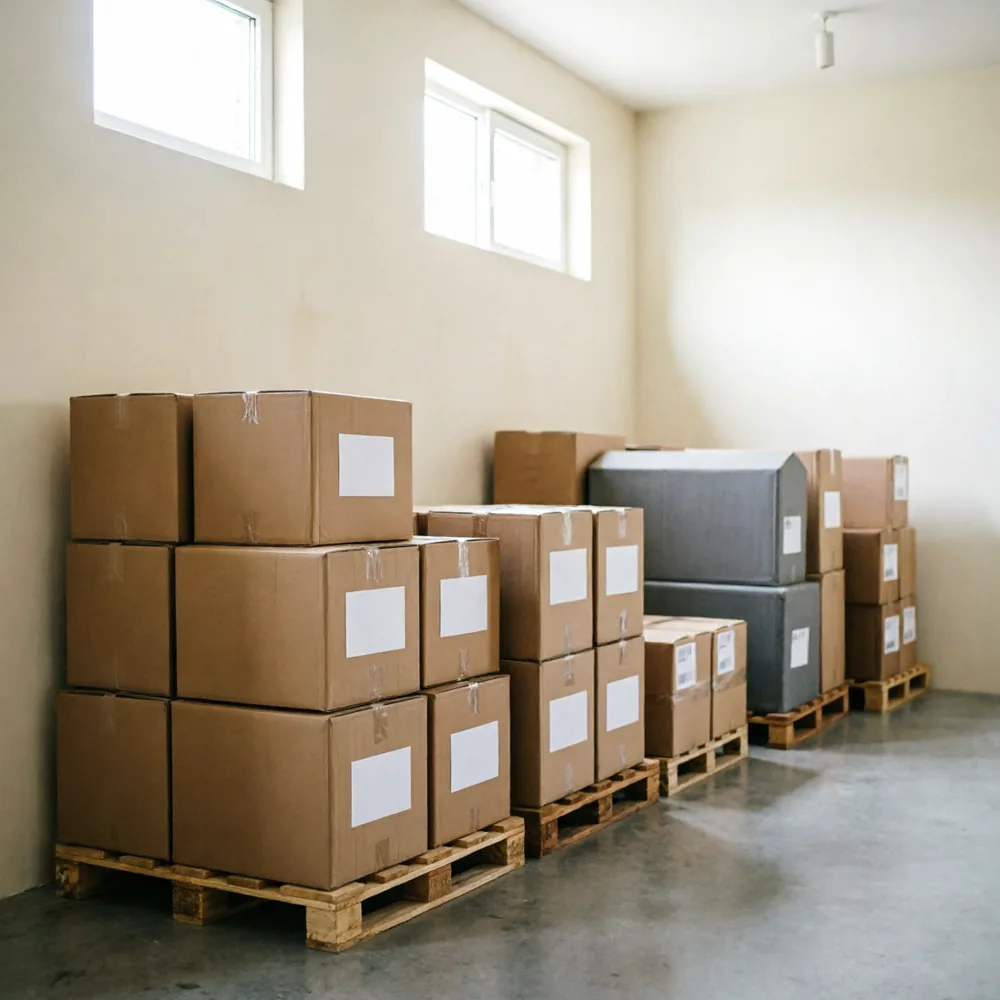
A brand name on a box doesn’t tell you which sofa is inside. Before dispatch, agree what the outer labels will show: order reference, item or module code, package number within the set (for example 2 of 3), and room or delivery phase on project orders. Ask for a sample label.
The US International Trade Administration lists package counts, marks, weights and descriptions among the contents of a packing list. On arrival:
- Count packages separately from finished sofas; one sofa may arrive in several cartons.
- Photograph each label and the carton condition, and match it to the packing-list line.
- Keep modules and hardware together as sets, and record any missing, duplicate or unclear labels.
- Don’t relabel a carton that looks wrong; record the discrepancy and get a traceable correction.
A matching label doesn’t replace an unpacking inspection.
What to Record if a Sofa Arrives With a Problem
Record the condition before repairing, cleaning or adjusting anything. The US Federal Trade Commission recommends gathering purchase documents, describing the problem and the outcome you want, and keeping copies of all communication.
- A photo of the whole sofa or module, then a close-up of the problem, taken from the same side.
- The packaging condition and label, the delivery date and when you first noticed the issue.
- The seller, order reference, model, fabric code, affected module and the final approved drawing.
- Anything already done: assembly, cleaning, adjustment, products used.
Describe what you see rather than the cause: “the front leg on module B moves at its fixing” is more useful than “the frame is defective”. If a section is unstable or has an exposed sharp part, stop using it. Keep the packaging until you’ve checked the seller’s instructions.
A message you can adapt
Order reference: [reference]. Delivered: [date]. Model or module: [identification]. I noticed [condition] at [location] on [date]. The attached photos show the whole piece, the affected area and the packaging label. Since delivery I have [actions, or none]. Please confirm the next inspection step. My requested outcome is [request].
Send it through the contact on your order. If you bought through a retailer, contact that seller. What happens next depends on the terms of your order and where you are; this guide doesn’t set a warranty period or remedy.
Delivery Information From YEINIHOME
When you send an enquiry, include the model, intended dimensions and any route restrictions (narrow doors, lift size, stairs), and ask for the transport dimensions of that configuration, the removable parts and the approved lifting points. For project orders, ask which label information can be included for your receiving team. Compressed (roll-packed) models travel in smaller cartons; see compressed sofas.
Frequently Asked Questions
How do I know if a sofa will fit through my door?
Compare the transport dimensions of the actual configuration with every opening and turn on the route, and have the delivery team review it.
Can I drag a sofa a short distance?
No. Dragging stresses the legs and joints even over short distances. Lift it at approved points.
Does removing the legs make side storage safe?
No. It changes the contact points but doesn’t make the arm or back load-bearing.
Does one carton mean one complete sofa?
Not always. Check the package count and grouping on the packing list.
Does a photo guarantee a replacement?
No. It documents the condition for review; any remedy is confirmed through the order’s process.
Sources and References
Canadian Conservation Institute: Handling heritage objects
Canadian Conservation Institute: Basic care of furniture and wooden objects
International Trade Administration: Common export documents