Buying Guides / Dining Furniture Guides
Dining Table Bases and Real Seating Capacity
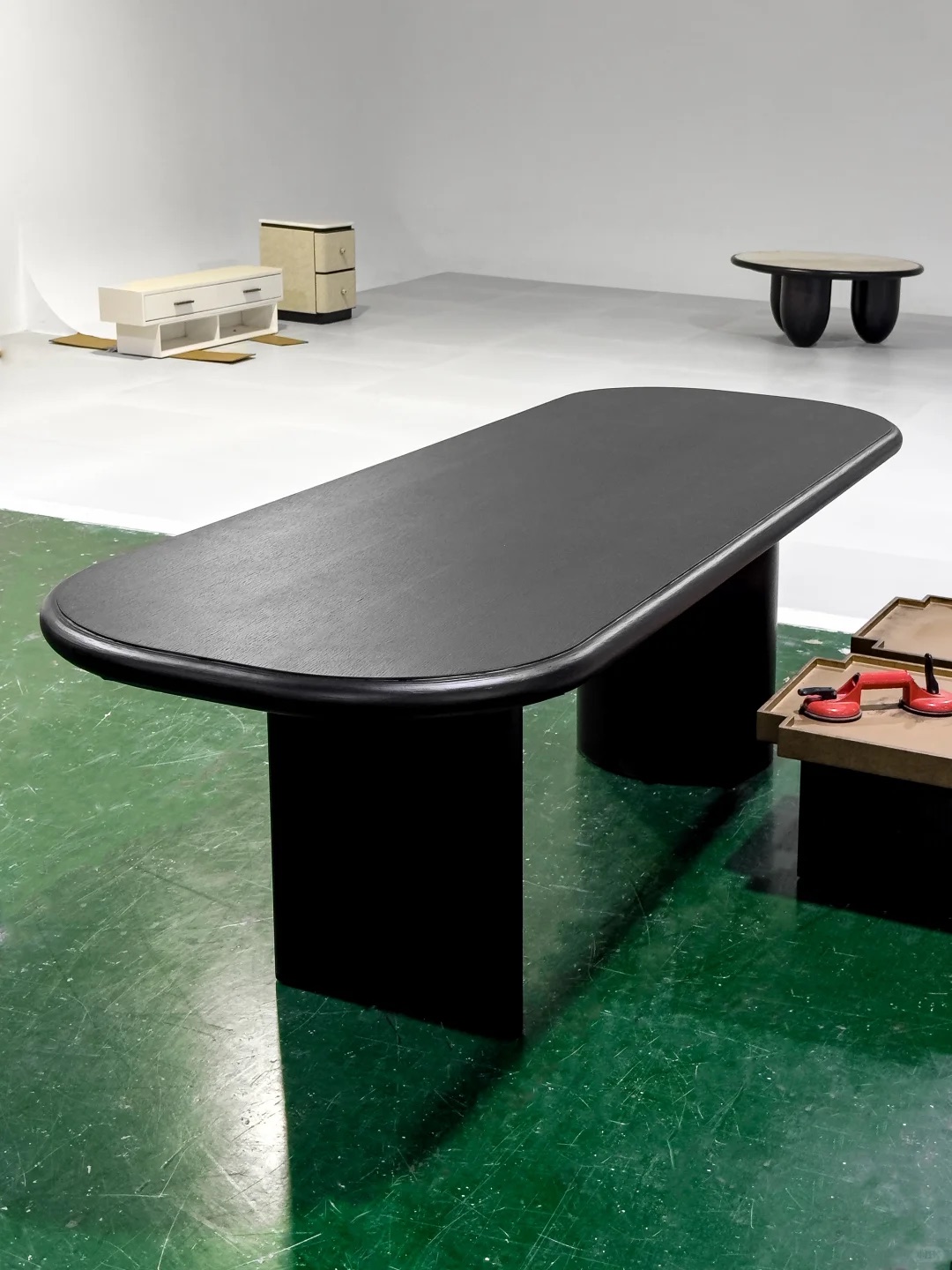
Assess seating capacity at each position around the actual table base. A clear tabletop edge can hide a leg, stretcher or pedestal that limits knee space or where a chair can be placed.
Request the Underside Drawing
Ask for a plan showing legs, pedestals, rails and overhangs. Keep the dimensions tied to the top size being ordered. A resized top on the same base may change the usable positions and needs confirmation rather than an assumption.
Place the Chairs Precisely
Use the outside width of the proposed chair and review its location relative to the supports. Check whether an end seat straddles a leg or whether two adjacent chairs compete for the same foot space. Allow the project reviewer to judge the occupied arrangement in context.
Test the Routine Tasks
Review sitting, standing, pushing chairs in and cleaning beneath the table. If the table will move for events, obtain its handling instructions and confirm the team can manage it. Keep a record of the approved seat positions rather than promising a count based only on top length.
Approval Record
- Understructure plan for ordered size
- Chair positions at sides and ends
- Occupied knee and foot space
- Handling and cleaning access
BSI describes safety, strength and durability requirements for non-domestic tables. BSI: BS EN 15372:2023 — Public Scope. Review the relevant test evidence separately from the room-fit exercise.
Measure table base legroom at the chair's actual position
Take the clear distance between obstructions where the chair enters. Do not substitute the distance between leg centres. Tapered or splayed legs may leave a different opening near the floor from the one just below the apron, so mark the measurement height on the drawing.
For a hypothetical check, suppose the clear opening between two legs is 1,160 mm and each proposed chair is 580 mm wide at its widest point. Two chair widths total 1,160 mm. That leaves no horizontal allowance within that opening. It is a reason to review the pair, not evidence that two occupied seats fit comfortably.
Even a positive remainder needs a physical or full-size layout review. Chair backs may be wider than seats, arms may approach the legs at an angle, and users need to enter and leave. Do not convert the remainder into a universal minimum clearance.
Record side seats and end seats separately
Label every proposed position on the underside plan. For each one, note the chair code, nearest obstruction and the result of sitting, rising and tucking in the chair. An end seat can meet a stretcher that does not affect the side seats. Adjacent seats also need to be reviewed together when their users share foot or elbow space.
The BS EN 15372 public scope concerns table safety, strength and durability. It does not turn this layout exercise into a test report or establish a seating capacity for the proposed room.
For YEINIHOME (言逸家) dining furniture, request the underside drawing for the ordered top and base together. If either changes, review the positions again and obtain written confirmation of the combination before retaining the earlier seat count.
Questions Before You Order
Does a Pedestal Automatically Increase Seating Capacity?
No. Its shape and footprint can still interfere with feet and chairs. Review each occupied position.
Can the Same Base Be Used With a Larger Top?
Ask the supplier to confirm the proposed combination and relevant evidence. Do not assume that changing the top leaves support requirements unchanged.
Can chair width alone establish table seating capacity?
No. It can identify an obvious conflict, but it does not account for occupied elbow, knee and foot space, chair movement or circulation around the table.
Continue Your Procurement Review
References
Sources reviewed October 22, 2026. Standards references are limited to publicly readable scope.